Built around the CBCA
Every document in the book cites the Canada Business Corporations Act by section, so the by-law, resolutions and certificate legend line up with the statute your corporation is under.
| Requirement | Section | What it means |
|---|---|---|
| Records to keep | s. 20 | Articles, by-laws, minutes, resolutions, register of directors, securities register |
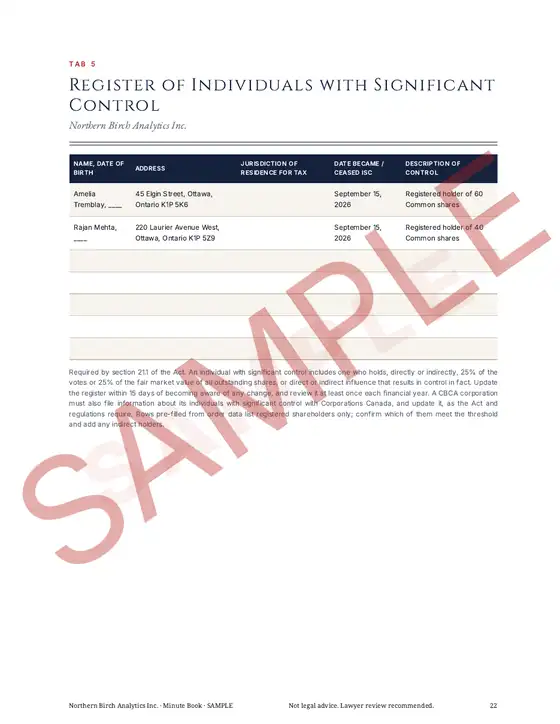
| ISC register | s. 21.1 | Individuals with significant control, updated within 15 days |
| Electronic records | s. 22 | Permitted if reproducible in readable form |
| No par value | s. 24 | All shares are without nominal or par value |
| Share certificates | s. 49 | Required contents and restriction legend at s. 49(8) |
| Director consent | s. 106(9) | A director absent from the meeting must consent in writing within 10 days or act as director |
| Audit exemption | s. 163 | All shareholders must consent |
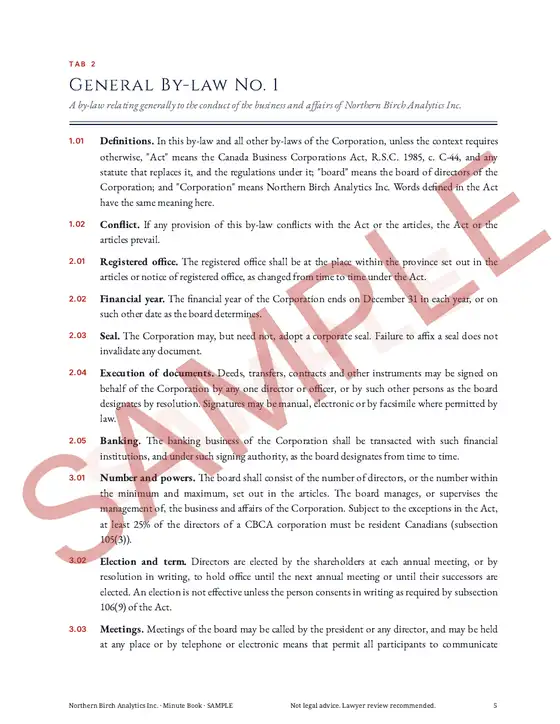
Federal corporations must also file their ISC information with Corporations Canada. At least 25% of directors of a CBCA corporation must be resident Canadians, subject to the exceptions in the Act.
Section references are summarized from the official statute. This is not legal advice.
What section 20 of the CBCA requires you to keep
A federal corporation must prepare and maintain, at its registered office or another place in Canada the directors designate, four groups of records: the articles and by-laws with every amendment and a copy of any unanimous shareholder agreement; the minutes and resolutions of shareholders; copies of the notices of directors filed under sections 106 and 113; and a securities register that complies with section 50.
Separately, the directors' own minutes and resolutions and adequate accounting records must be kept, and the accounting records must be retained for six years after the end of the financial year they relate to. A corporation that fails to comply without reasonable cause commits an offence punishable by a fine of up to $5,000.
Source: laws-lois.justice.gc.ca
Registered office and access to the book
A federal corporation must always have a registered office in the province named in its articles. The directors may move it within that province, but a notice of the new address must reach Corporations Canada within fifteen days.
Shareholders and creditors, their personal representatives and the Director may examine the section 20(1) records during usual business hours and take extracts free of charge. Each shareholder may also ask for one free copy of the articles, the by-laws and any unanimous shareholder agreement. Records may be kept outside Canada only if they can be inspected through a computer terminal or other technology at the registered office or another designated place in Canada during regular office hours.
Source: laws-lois.justice.gc.ca
The federal annual return
Every federal business corporation files an annual return with Corporations Canada within 60 days after its anniversary date, which is the date it was incorporated, amalgamated or continued. Filing online costs $12; filing by email or mail costs $40. Corporations Canada sends a personalized reminder and, if nothing is filed, a default notice roughly 90 days after the anniversary.
The annual return is not the T2 income tax return, which goes to the Canada Revenue Agency. A corporation that keeps missing its annual return risks dissolution, and the ISC information has to be filed in the same transaction.
Source: www.ised-isde.canada.ca
Filing ISC information with Corporations Canada
Since January 22, 2024, corporations under the Canada Business Corporations Act must also file their ISC information with Corporations Canada: when they incorporate, every year together with the annual return, within 15 days of recording a change in the register, and within 30 days of a certificate of amalgamation or continuance.
Some of what is filed becomes public: the full legal name, the dates control began and ended, the description of control, and the address for service, or the residential address if no address for service is given. Date of birth, citizenship and tax residence are not published, and information about anyone under 18 stays private until they turn 18. Not filing can lead to a refused certificate of compliance, administrative dissolution, or a fine of up to $100,000.
Source: www.ised-isde.canada.ca
Federal share certificates
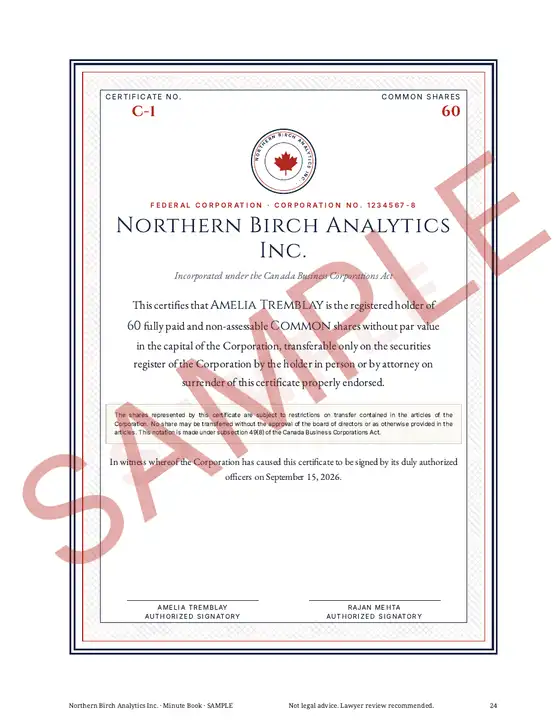
Section 24 says shares of a federal corporation are in registered form and have no nominal or par value. Under section 49(7), the face of each certificate states the corporation's name, the words Incorporated under the Canada Business Corporations Act or subject to the Canada Business Corporations Act, the holder's name, and the number and class of shares with any series designation.
Section 49(8) matters for private companies: a transfer restriction, a lien in favour of the corporation, or a unanimous shareholder agreement is not effective against a transferee without actual knowledge of it unless it, or a reference to it, is noted conspicuously on the certificate. A director, an officer or a transfer agent signs, and a printed signature is allowed.
Source: laws-lois.justice.gc.ca
When a federal director's election takes effect
Under section 106(9), someone elected or appointed as a director who was present at the meeting and did not refuse the office becomes a director. Someone who was absent becomes a director only if they consented in writing before the election or within ten days after it, or if they have acted as a director under that election. A signed consent filed in the minute book removes any doubt.
Source: laws-lois.justice.gc.ca