Preview sample pages
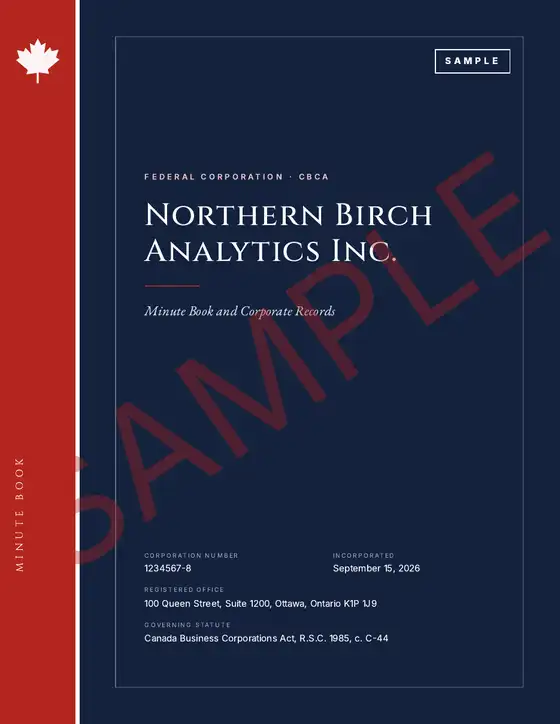
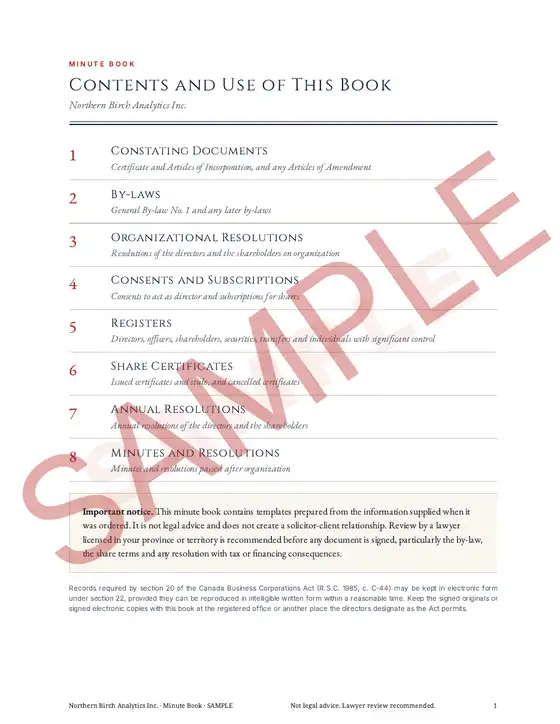
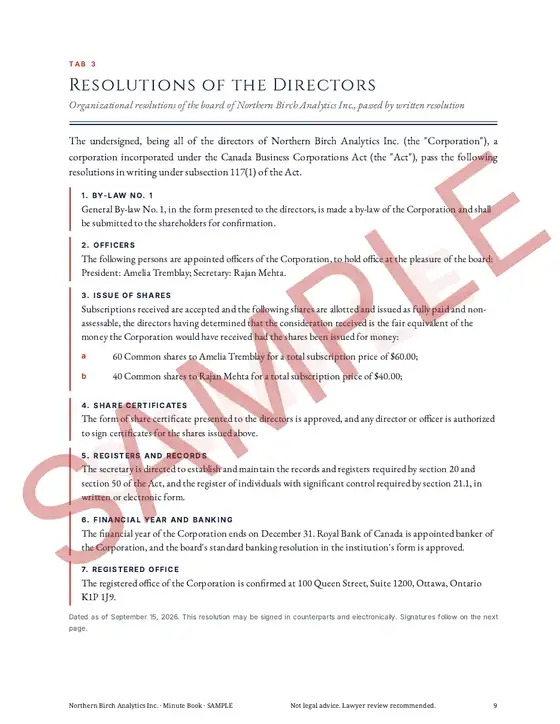
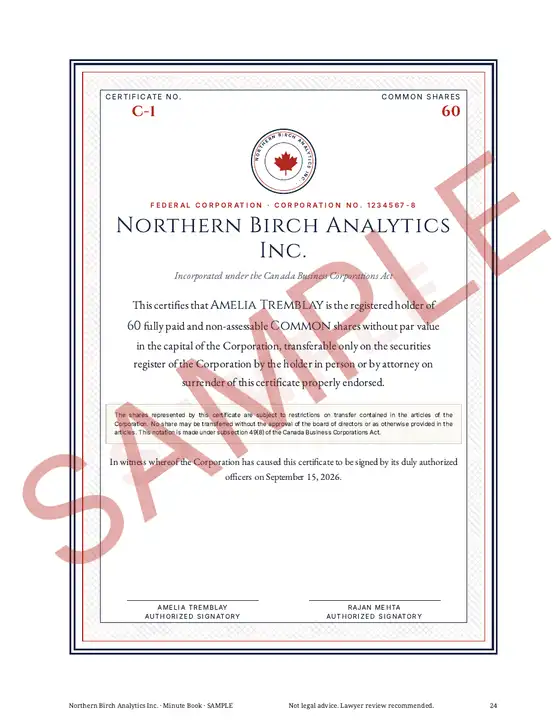
Four pages from a complete sample book for a fictional company, marked SAMPLE. Your book is prepared with your own corporation's details after checkout.
Previews are shown at reduced resolution. The full book is delivered as a print-ready PDF after purchase.
What the full book covers, by statute
The sample pages above come from a federal book. In a CBCA corporation the book holds the section 20 records: articles and by-laws, shareholder minutes and resolutions, copies of directors' notices and the securities register, along with directors' resolutions and the section 21.1 ISC register. An Ontario book follows section 140 of the OBCA and adds a register of directors with residence addresses and a register of ownership interests in land in Ontario.
Previews are intentionally limited. The complete book is prepared with your corporation's own name, number, directors and shareholders only after you order.
Source: laws-lois.justice.gc.ca
Ontario's land register
Ontario adds a record that the federal Act does not have: a register of the corporation's ownership interests in land in Ontario. It must identify each property and show the date it was acquired and, where applicable, the date it was disposed of. Copies of deeds, transfers or similar documents that show the municipal address, the land registry or land titles division with the property identifier number, the legal description and the assessment roll number must be kept with it. A corporation that owns no Ontario land keeps the register blank rather than leaving it out.
Source: www.ontario.ca
Written resolutions and one-shareholder meetings
Under section 142 of the CBCA, a resolution in writing signed by all the shareholders entitled to vote on it is as valid as if it had been passed at a meeting, and a written resolution dealing with everything an annual meeting must handle satisfies all of the Act's meeting requirements. A copy must be kept with the minutes of shareholder meetings.
Where a corporation has only one shareholder, that shareholder present in person or by proxy constitutes a meeting. Unless the by-laws say otherwise, a quorum is the holders of a majority of the voting shares. Most owner-managed corporations therefore run their year-end business entirely on signed written resolutions kept in the minute book.
Source: laws-lois.justice.gc.ca
Registered office and access to the book
A federal corporation must always have a registered office in the province named in its articles. The directors may move it within that province, but a notice of the new address must reach Corporations Canada within fifteen days.
Shareholders and creditors, their personal representatives and the Director may examine the section 20(1) records during usual business hours and take extracts free of charge. Each shareholder may also ask for one free copy of the articles, the by-laws and any unanimous shareholder agreement. Records may be kept outside Canada only if they can be inspected through a computer terminal or other technology at the registered office or another designated place in Canada during regular office hours.
Source: laws-lois.justice.gc.ca
Seal and registered office
Section 13 of the OBCA says a corporation may, but need not, have a corporate seal. Section 14 requires a registered office in Ontario at all times, at the location in the articles or as changed by resolution.
Source: www.ontario.ca
Ontario government fees that touch the minute book
The Ministry charges $300 to incorporate, whether online (processed immediately) or by mail (15 business days). Articles of amendment cost $150, amalgamation $330, revival $330 and articles of dissolution $25. Initial returns, notices of change and annual returns under the Corporations Information Act cost nothing when filed with the Ministry.
Each of those filings produces a certificate or confirmation that belongs in the minute book next to the resolution that authorized it.
Source: www.ontario.ca
Federal share certificates
Section 24 says shares of a federal corporation are in registered form and have no nominal or par value. Under section 49(7), the face of each certificate states the corporation's name, the words Incorporated under the Canada Business Corporations Act or subject to the Canada Business Corporations Act, the holder's name, and the number and class of shares with any series designation.
Section 49(8) matters for private companies: a transfer restriction, a lien in favour of the corporation, or a unanimous shareholder agreement is not effective against a transferee without actual knowledge of it unless it, or a reference to it, is noted conspicuously on the certificate. A director, an officer or a transfer agent signs, and a printed signature is allowed.
Source: laws-lois.justice.gc.ca
Form of Ontario records and certificates
Since a 2023 amendment, section 139 of the OBCA says a required record may be kept in any form. The corporation must take adequate precautions against falsification and be able to produce the information in an accurate, intelligible form within a reasonable time for anyone entitled to see it.
Under section 22, Ontario shares are in registered form without nominal or par value. Section 56 lists what goes on the face of a share certificate: the corporation's name, words such as Incorporated under the law of the Province of Ontario, the holder's name, and the number and class of shares. A director's election or appointment is effective only with written consent given before or within ten days after it, although a later written consent also validates it (section 119(9) and (10)). Section 148 lets a corporation that is not an offering corporation skip the auditor for a year if all shareholders consent in writing.
Source: www.ontario.ca